Showing posts with label church. Show all posts

September 13, 2012

Basilica de Nuestra Sra del Rosario y Convento de Santo Domingo, Buenos Aires

The Dominican monastery and its Basilica de Nuestra Sra del Rosario y Convento de Santo Domingo (Our Lady of the Rosary and Convent of St Dominic) is located on Defensa 422, the street which hosts the Sunday market which extends for about a kilometer and leads to the famous San Telmo antique fair.  The baroque basilica was constructed 1751-1773, using, like so many other churches in Buenos Aires, the Neoclassical barrel vault modified to accommodate large domes.  The numerous altars approached by the two side aisles are highly decorated in the Baroque fashion.  I found the contrasts in lighting to be severe (dark darks and brilliant yellow-orange lights) and a bit more of a challenge than I could manage to my satisfaction.  The ceiling above the right aisle is badly crumbling, so netting is in place to protect visitors and the faithful.  Damage is also evident in the nave's ceiling (darkened areas), all of which will be remedied in the fullness of time.

The basilica was shelled during the British invasion of Buenos Aires in 1807.  A few 'enemy' flags can be seen in the nave.  A monument in the basilica's courtyard (not shown in this blog) serves as a mausoleum for General Belgrano, famed for his leadership in the Argentine war for independence from Spain in 1816.

Strangely, I can find nothing in English about this beautiful church.  While not off the beaten path, it is not included in any of our numerous tour books, yet it deserves a visit.  If nothing else, it offers a place to sit down to people tired from walking the cobble stone street while visiting the market on Defensa.


September 10, 2012

Catedral Metropolitana de Buenos Aires

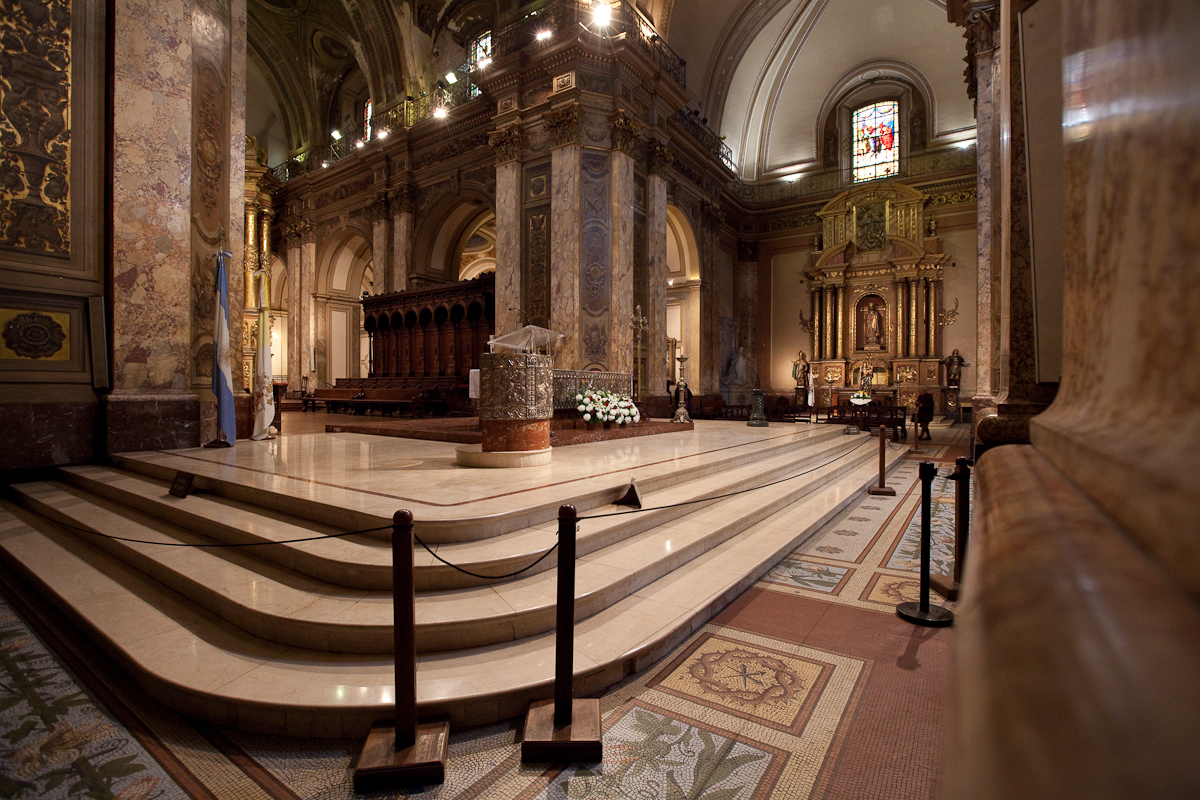
The Metropolitan Cathedral of Buenos Aires is on San Martin and Rivadavia, on the Plaza de Mayo.  It has been thoroughly rebuilt since its founding in the 16th century.  After collapsing in 1752, the nave and towering dome were rebuilt using the Romanesque barrel vault but in the neo-Renaissance style, supporting domes.  The facade recalls the neoclassical fashions so popular in the 19th century.  The richly decorated altars along both side aisles were constructed in the 1700s, again in either neo-Renaissance and neo-Baroque styles. 

Visitors were allowed to wander at will when no worship services were being conducted.  Tasteful recorded Renaissance choral music was played softly, establishing a meditative spirit.  This church, like all I have visited thus far in Buenos Aires, is built to exclude light, at least when compared with Gothic structures in France and England.  Here, summers can be impossibly hot, and at times people wish to escape its overwhelming brightness at noon, when Masses are said or sung. 

The floors throughout the cathedral feature fascinating tiles with decorative floral patterns.  One could spend years just studying tiles in Argentina.


 From the right aisle, you can enter the impressive mausoleum of General San Martin, guarded by figures representing Argentina, Peru and Chile, the three areas which achieved freedom under the General's efforts.